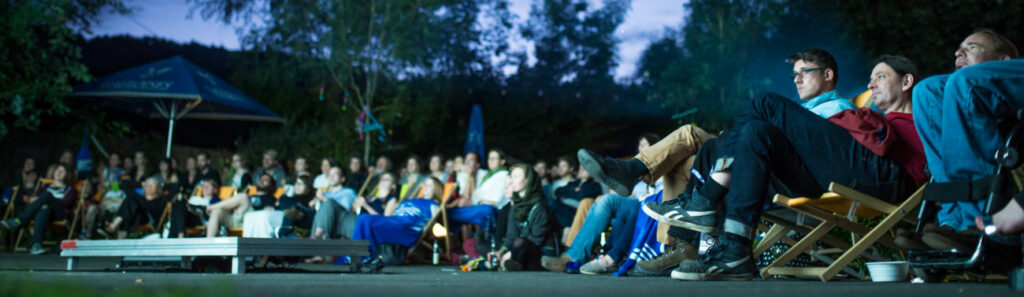
The OpenEyes Film Festival is an independent international short film festival in Marburg, Hessen. This open-air festival annually showcases the latest national and international short films of all genres in a public competition over four to five festival days. The festival provides a platform, especially for independent, local, or marginalized short films. The Film Cabinet (formerly known as the ‘Garage Cinema’ | ‘Garagenkino’) additionally offers a low-threshold opportunity to submit films just before the festival starts or spontaneously, outside the competition, to present them to an interested audience. The displayed films aim to realize diversity on various levels. Original techniques, different aesthetics, and innovative ideas are given space to present cultural diversity, interesting and critical questions, and current issues in a stimulating program.
Through close connections to universities and their own seminars, such as at Philipps-University Marburg, the festival also focuses on promoting emerging talent and sustainable structural strengthening away from major cities. The production of audio descriptions, subtitling of films, and an inclusive pricing model for admission are part of an inclusive approach.
In 2024, the film festival will take place for the second time on the grounds of the Waggonhallen area. A significant portion of the festival and film program takes place in the open air on the premises. Indoor venues include the on-site theater hall. Other areas of the premises are also integrated into the festival, for example, for numerous events in the program framework.
All selected films will be screened in the competition (audience competition), with the exception of special screenings such as retrospectives, collaborations, or similar events. The competition films receive awards in various categories, typically including: fiction, documentary, experimental film, music video, and animation. In addition, there are annual thematic festival focuses with their own competitions. The awards do not come with monetary prizes. The entire film program is divided into 10-25 film blocks over a period of four or five days.
The competition program is selected from open film submissions, with an average of around 800-1500 entries. Submitted films must not be older than one year or two years if they have not had a festival screening in Germany before. The festival only accepts films submitted directly through its own submission platform. The submission phase begins in December of the previous year and typically ends in April of the festival year. The festival has developed its own film database, which serves as a submission and archiving platform, as well as a programming tool. Its content is made available for research purposes to external organizations and individuals. The archive contains approximately 12,000 short films [as of 2023]. Many films have their German, European, or world premieres at the festival. A significant number of films are personally represented by filmmakers attending the festival.
The screening and program selection are carried out by approximately 10-25 individuals from the film and festival industry, with the composition of the selection committee changing regularly. Each year, about 80-120 films are chosen for the festival. The maximum film length is 30 minutes. While there are no specific thematic or content requirements, the festival places special emphasis on films that are generally underrepresented due to their subject matter or production circumstances.
Through the personal invitation of filmmakers every year, the OpenEyes team promotes contact with the directors, thereby creating a forum for exchange and getting to know each other. Filmmakers comment on their films before or after the screenings and are also readily accessible: during the festival or at the Filmmakers’ Breakfast at the Rotkehlchen.
The work and organization of the film festival are divided into various areas: the practical seminar, the selection group, and the core organizing team. In addition, there are various individuals who work for or at the festival.
The core organizing team consists of approximately 8-12 individuals who collaboratively plan the concept and execution of the festival, along with all related tasks, and actively contribute to their implementation with a high level of personal, and in some cases, volunteer commitment.
The selection process and preliminary program selection from the competition submissions are handled by a group of about 10-20 individuals who work in varying compositions each year. Together with the festival management, they curate the festival program and create film descriptions for print and online publications.
The overall graphic concept/art direction has been annually advertised and awarded nationwide since 2011, primarily at art and design schools.
1994
The OpenEyes Film Festival is taking place for the first time under the name “Mittelhessisches Amateurfilmfest” (Central Hessian Amateur Film Festival). The former so-called ‘Video Group’ of Café Trauma, which was running a form of community cinema work called the ‘Mittwochskino’ (Wednesday Cinema) at that time, responded to the call of the Mittelhessischen Kultursommer (Central Hessian Cultural Summer) for an event with the theme “Kultur auf der Höhe” (Culture on the Heights). They came up with the idea of hosting a nighttime open-air film screening at the Burgruine Amöneburg.
1996
Two years after its founding, the concept of the “Amateur Film Festival” is initially changed with the introduction of the name “OpenEyes Film Festival.” The focus is now intended to be broader than “Central Hesse” and “amateur.”
2007
The OpenEyes Film Festival will now take place at the New Botanical Garden in Marburg.
2010
The OpenEyes Film Festival is relocating to the old gasworks site of the g-Werks in Marburg.
The ‘Film cabinet’, as an additional format to the main program, is established as a ‘Garage Cinema’ (‘Garagenkino’) and has since primarily focused on amateur short films.
For the first time, the OpenEyes Film Festival is offering a project seminar for students of the B.A. Media Studies and B.A. Art, Music, and Media at Philipps-University Marburg. This seminar focuses on the planning, financing, organization, and execution of a film festival, which has been offered every year since.
2011
The categories of the Audience Awards, ‘University Film’ and ‘Non-University Film,’ are being changed; from now on, the audience will evaluate the short films in the categories of ‘Fiction,’ ‘Documentary,’ ‘Animation,’ and ‘Experimental Film/Music Video.’
2011-2019
The film festival presents monthly, under the title “OpenEyes Filmfest – The Series,” moderated short film compilations from its own archive, focusing on thematic, technical, or aesthetic aspects.
2020
Cancellation of the festival due to the COVID-19 pandemic.
2021
The OpenEyes Film Festival will now be organized by the newly established ‘Förderung der Filmkultur in Marburg e.V.’ (Association for the Promotion of Film Culture in Marburg e.V.)
Due to the increased requirements for hygiene measures related to the COVID-19 pandemic, the film festival will take place on a parking lot directly adjacent to the cultural center.
In connection with a project funded by Aktion Mensch and in cooperation with the Deutsche Blindenstudienanstalt (German Institute for the Blind) and the AG Sprechwissenschaft (Speech Science Working Group) of Philipps University, audio descriptions for a selection of festival films were produced for the first time. This project was further supported by the Heidehof Foundation in 2023.
2023
The film festival will now take place on the entire premises of the ‘Waggonhalle’ cultural center.